
ORANIA REFUSES TO DIE

U.S. President Donald Trump confronted South African President Cyril Ramaphosa on Wednesday (May 21) with claims that white landowner farmers are being targeted and killed in the country, all but repeating the pitiful public spectacle in the Oval Office when Trump humiliated V. Zelensky, president of Ukraine.
The show in Washington's Oval Office against Ramaphosa was an embarrassing and macabre planned act, where Donald Trump, the white supremacist and president of the United States, tried to humiliate his South African guest by presenting him with social media videos of criminal violence against whites and a 2011 video of a black extremist leader – Julius Sello Malema (then president of the African National Congress Youth League, ANC) - singing "Dubul' ibhunu" ("Shoot the Boer"). [1]
Neither Trump nor Ramaphosa mentioned the fact that Malema was convicted by the South African justice system that same year and that the song was banned for inciting hatred and breaking UBUNTU, a tribal principle promoted by Mandela that means "I am because we are" and represents unity and empathy among the human race.
South Africa is a country that was subject to a harsh regime of white supremacy between 1948 and 1994, a highly racist, discriminatory, and segregationist system legalized by laws, regulations, provisions, and arbitrary decrees of the white minority in power. This white minority was the heirs of the colonialist power of England, Holland, and other European countries, until Mandela's arrival as president of the country (1994).
The problem is that racism is not only a mental or ideological attitude of an oppressive social elite that is injected into the consciousness of the oppressed: From 1948 to date, racism has taken deep roots in the economic and productive structure of the country, in the spatial segregation by groups and even in the educational models that even today, it continues to hinder true social and community unity, whose current social toll is high levels of delinquency, gang actions, and violent crime.
Trump, in his first term, already wielded that twisted narrative about a genocide against the white minority in South Africa, ordering his secretary of state at the time, Mike Pompeo, to investigate the attacks on white farmers in the South African countryside. Malema, that aforementioned extremist black leader, on August 23, 2018, strongly criticized Trump-1's claims and claimed that the US president and that conspiracy theory was trying to interfere and block the legitimate rights of the non-white population of South Africa to have access to land to make it produce.
This argument was repeated this time in the Oval Office ambush on 21-05-2025 against Ramaphosa, accusing him of confiscating white landowners in South Africa without retribution.
Access to land? Let's take a quick look at the landscape of land tenure and demographic situation: South Africa has a total population of 63.9 million people, of which 51.5 million belong to the indigenous black population (82%) while the white population is 7.2%, less than 5 million people[2].
There are a total of 122 million hectares (ha) of arable land in South Africa, of which about 72 million hectares are registered as private property on farms, 26 million hectares are owned by whites and only 4.5 million hectares, belong to indigenous black people.
Despite the displacement of the apartheid system under the leadership of Nelson Mandela, there are still many pending tasks for its eradication in the economic, cultural, and ideological spheres. The tenure structure is one of them, where it is observed that those 26 million hectares are still in the hands of whites, who are 7.2% of the population, while the native black population, which constitutes more than 82% of the total population, owns only 4% of the private arable land.
This is the structure that Ramaphosa is trying to change with land reform, starting with the bank of idle land, which "coincidentally" is in the hands of the recalcitrant white minority. Trump had already lashed out at South Africa in February of this year 2025, instigated by Elon Musk, who was born among that white minority that feels threatened by social change. Trump ordered an end to funding to South Africa, accusing that country of hostile policies toward the U.S. and of allowing the persecution of white farmers, and has now spoken directly to Ramphosa of "genocide against whites" without any evidence from any specialized international body and not even under a special report from any U.S. government agency. The photos and videos exhibited by Trump to the international press are materials from social networks.
Genocide in South Africa, but not in Gaza?
Here we are witnessing an aberration: Dozens of organizations from various countries and at the international level, for years, have documented the ethnic extermination carried out by Israel against the Palestinian people and Trump is not only silent about this genocide but continues to arm and encourage Israel to accelerate its racist extermination: According to the Gaza Ministry of Health, Between October 7, 2023, and May 21, 2025, at least 53,655 Palestinians have been killed, 121,950 have been injured, most of them civilians, children and women. This Palestinian death should count for as much as any racially motivated white person in South Africa if this were happening. Is there no genocide against the Palestinians, only unproven genocides against a white minority in South Africa?
We have said that apartheid in South Africa was "displaced", not eradicated or dismantled, because a small extremist and minority sector of the white remnants – "Afrikaners" – resists even today to live on equal terms with that 80% of the native black population. [3]
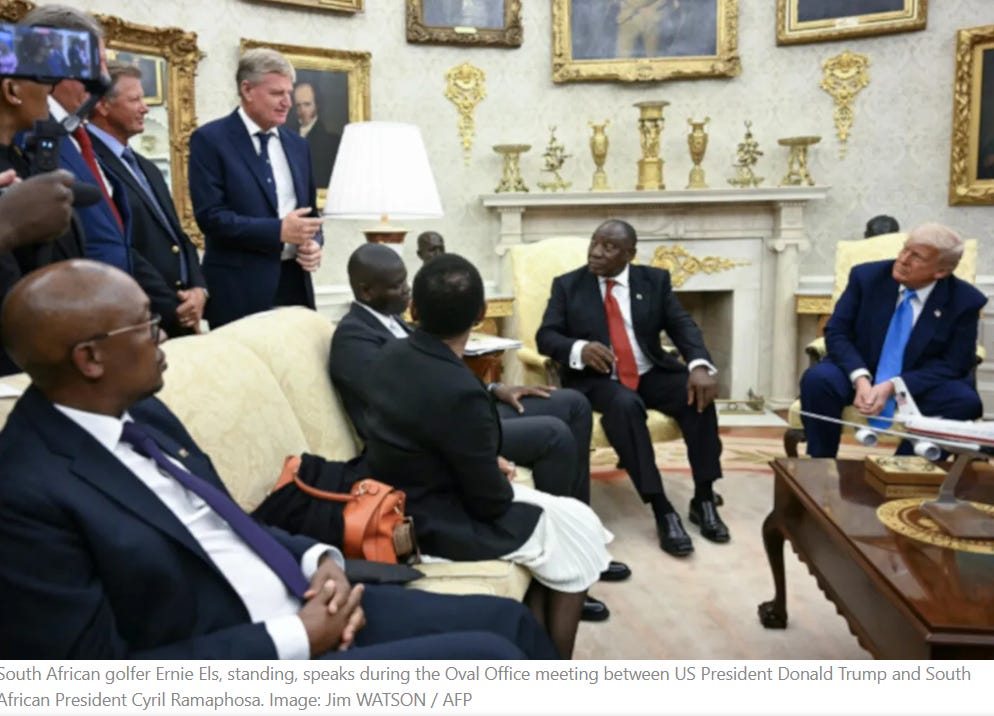
It must be said that not all of South Africa's white population adopts white supremacist positions: Ramaphosa was accompanied to the meeting with Trump by two prominent white South African golfers, Ernie Els, and Retief Goosen, and by another white man, the second richest man in South Africa, Johann Peter Rupert[4].
Ernie spoke to Trump denying the institutional existence of violence or discrimination against whites, although accepting the reality of widespread criminality and white billionaire J.P. Rupert backed up this clarification by speaking directly to Trump, who ignored him.
Epilogue: White Extremist Resistance Against History
On the eve of the collapse of apartheid, in 1990, in the face of the paradigm shifts that were happening in the country, a group of 40 fanatics of the old system of white supremacism in the country, decided to buy a large plot of land in the province of the Northern Cape, 7 hours from Pretoria. The group was led by Carel Boshoff, an Afrikaner nationalist, and Hendrik Verwoerd's son-in-law, and among them was also Betsie Schoombi, the widow of Hendrik Frensch Verwoerd.
Hendrik Frensch Verwoerd had been assassinated in the South African Parliament in 1966. He was a Dutch-born guy (1901) who became prime minister of South Africa from 1958 until the day of his assassination in September 1966. From power, he was one of the main architects of apartheid, which had already dominated the country since 1948. For example, it created the Bantustans, ghettos where the black population was locked up without the right to free movement and generated the entire network of laws that established the apartheid system against blacks and other "non-white" races. It institutionalized the arbitrary spatial distribution of black communities, towards inhospitable, unproductive, and isolated places and prevented black people from accessing white education and health services.
On the other hand, the land bought by Boshoff and his group of Afrikaners in 1990 was constituted as a refuge from black social and political advance, in Orania, a former workers' station for the construction of the largest hydroelectric dam in South Africa, the Vanderkloof Dam, on the Gariep River.
Orania welcomes whites who identify as Afrikaners and speak Afrikaans. Black people are not allowed to settle, they have their own currency and advocate self-determination against the South African state.
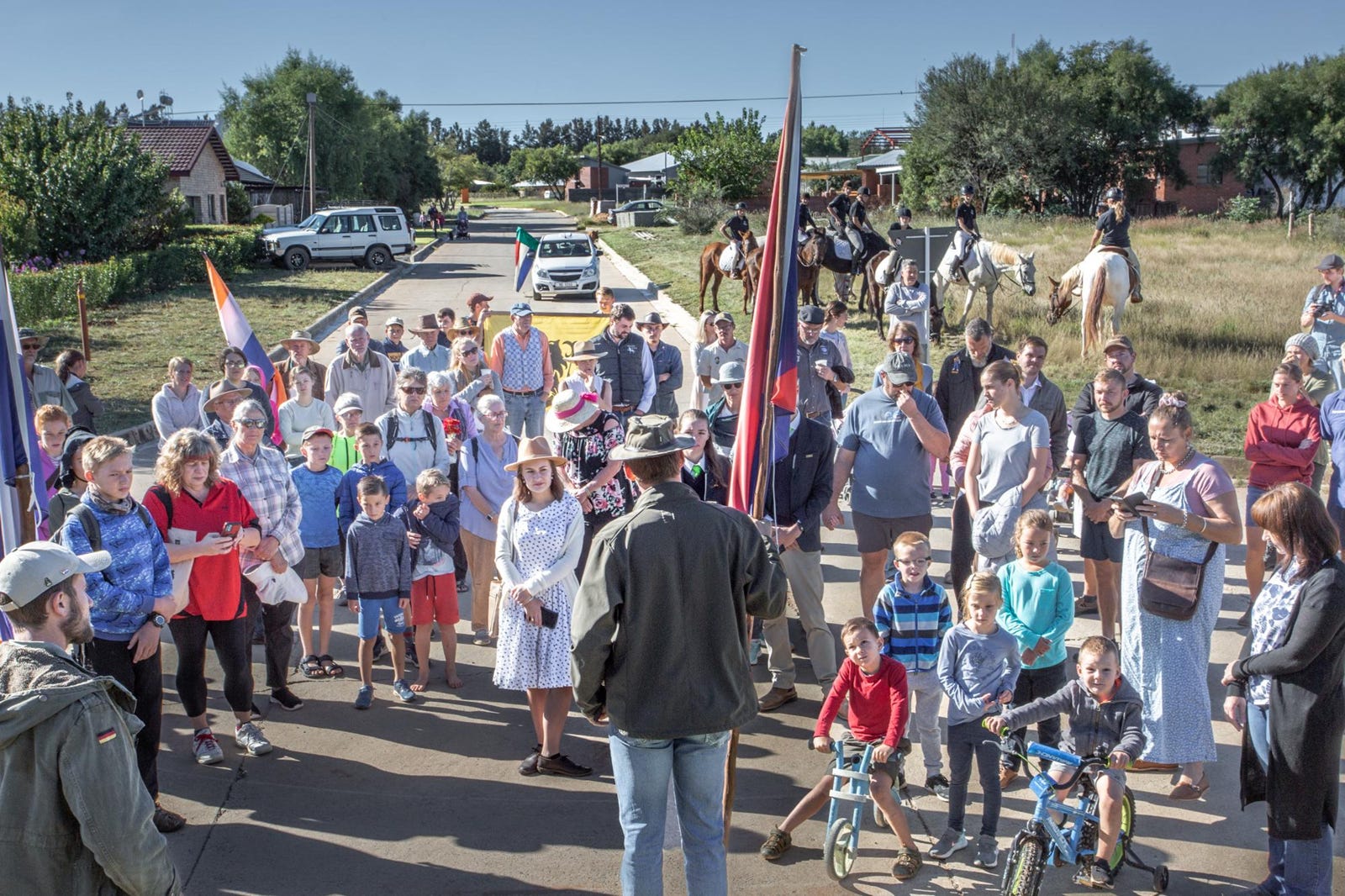
Orania has grown (it has about 8,000 hectares of land and less than 2,500 people) and is driven by isolationist and self-sufficient thinking, favored by the permissibility of the South African law on freedom of movement and settlement.
Nelson Mandela visited Orania on August 15, 1995, and had a cup of tea with Betsie Schoombi, the widow of Hendrik Frensch Verwoerd, in a symbolic act of détente and non-judgmental communication, but declared that it was not possible to establish exclusive territories for whites.
Orania, however, refuses to die.
[1] "Boer" in South Africa refers specifically to farmers descended from Dutch, German, and French settlers established in the 17th century who gave rise to the apartheid system between 1948 and 1994.
[2] Fuente: South Africa Gateway
[4] Johann Rupert is a South African businessman and chairman of Richemont, one of the world's largest luxury companies, which owns brands such as Cartier and Montblanc. He also runs Remgro, an investment conglomerate with interests in sectors of mining, technology, and agriculture.
In: https://www.theroot.com/the-story-behind-the-mystery-white-billionaire-who-told-1851781874